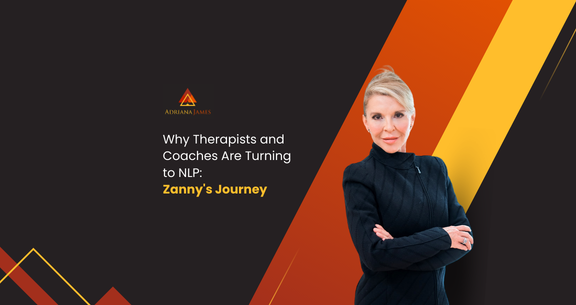
Why Therapists and Coaches Are Turning to NLP
More therapists and coaches are integrating NLP (Neuro-Linguistic Programming) into their work, not to replace therapy, but to accelerate transformation.
For Zanny Anderson Jarvis, trained in Clinical Mental Health Counseling, NLP filled the gap between insight and lasting change. She understood why clients struggled. NLP showed her how to shift what drives behavior beneath awareness – the unconscious mind.
If you’re a therapist or coach wondering whether NLP training could enhance your work, her journey offers insight into what changes, both professionally and personally.
When Zanny Anderson Jarvis discovered NLP, she was neck-deep in her Master’s degree in Clinical Mental Health Counseling.
She was learning theory, diagnosis, therapeutic models – all the frameworks that help people understand why they struggle.
But something wasn’t sitting right.
“There wasn’t much talk about the unconscious mind… maybe a little Freud here and there, but it wasn’t a big emphasis,” Zanny said.
That gap between insight and actual transformation kept nagging at her.
What Is NLP for Therapists and Coaches?
NLP for therapists and coaches is the integration of unconscious mind techniques with traditional counseling and coaching models. It focuses on shifting emotional patterns, internal representations, and language structures that drive behavior beneath awareness.
Rather than replacing therapy, NLP enhances it, giving practitioners structured tools to create faster, deeper change.
The Part That Was Missing
Zanny completed NLP Practitioner training in 2020, while still in grad school. What she encountered there fundamentally challenged how she understood change.
“I didn’t realize the profound impact of the unconscious mind—and how it governs 90% of our behaviors.”
For someone trained in conscious processing like talk therapy, cognitive reframing and insight work, this was a completely different entry point.
NLP didn’t replace her clinical background. It filled in what was missing.
It gave her a way to work with the part of the mind that drives behavior beneath awareness. The part that most traditional therapy models acknowledge but don’t always know how to access directly.
Does NLP Replace Traditional Therapy?
No. NLP does not replace therapy. Many clinicians use NLP alongside attachment theory, CBT, and other therapeutic modalities.
While traditional therapy often focuses on conscious processing and insight, NLP works directly with unconscious patterns, helping clients to shift emotional imprints and internal strategies more efficiently.
For therapists like Zanny, NLP filled the gap between understanding a problem and transforming it.
Going Deeper: Master Practitioner
A year after Practitioner training, Zanny worked with an NLP Master Practitioner coach in Maui. Through that work, she experienced deep shifts in her own relationship patterns and things she’d intellectually understood but hadn’t been able to fully change.
That’s when she knew she needed to go deeper.
“I immediately jumped on board. I knew this was the framework to uplevel my work.”
She enrolled in Master Practitioner training and and found it very in-depth.
“It was very intensive… and incredibly profound.”
But that intensity wasn’t necessarily the workload. It was about what it required of her.
“That intensity teaches you a lot about yourself. It gives you the tenacity required to become a successful coach.”
It wasn’t just about learning techniques. It was about building the internal capacity to hold space for real transformation – in herself and in others.
NLP Meets Attachment Theory
Zanny’s specialty is relationships and attachment dynamics. She helps people rewire anxious and avoidant patterns into secure relating, which is the type of work that’s deeply emotional and often rooted in early childhood experiences.
What NLP added was precision. And empowerment.
“Approaching this work from an NLP perspective empowers people in ways they used to feel disempowered.”
One of the biggest shifts came through language.
“I also recognized how my language was limiting me. NLP taught me how to be at cause.”
Instead of clients seeing themselves as broken by their past, NLP gave them a way to reclaim authorship of their future. Not by denying what happened, but by changing their relationship to it.
From Effect to Cause
If you are a therapist or coach looking to deepen your impact, the FasTrak™ NLP Practitioner Certification provides structured training in unconscious change work.
This distinction of being at effect versus being at cause is one of the most powerful concepts Zanny shares.
“So many people are walking around being at effect…’this happened to me,’ ‘my trauma happened to me.'”
NLP doesn’t deny emotional reality. It doesn’t bypass grief or minimize pain.
But it reframes where power lives.
“Triggers become lessons. Even discomfort becomes part of evolution.”
This isn’t about toxic positivity or pretending everything is fine. It’s about reclaiming agency in how you respond to what’s happened.
And that shift, from victim to author, changes everything.
Why Therapists Add NLP Training to Their Practice
Therapists and coaches often pursue NLP training to:
-
Work directly with unconscious drivers of behavior
-
Facilitate faster emotional release
-
Improve communication precision
-
Reduce repetitive session cycles
-
Help clients move from insight to action
For many professionals, NLP becomes the bridge between awareness and sustainable change.
Values, Identity, and Living Congruently
Through Master Practitioner training, Zanny also deepened her understanding of values levels thinking, which is the different worldviews people operate from, often without realizing it.
She recognized herself as someone integrating Values Level 5 (individual achievement and success) with Values Level 6 (heart-centered contribution and service).
And she saw how many people struggle to reconcile those two and can get stuck feeling torn between ambition and compassion, success and authenticity.
“There’s no better or worse values level… but recognizing where you are gives you choice.”
For Zanny, NLP became the tool that allowed alignment. Alignment between purpose, prosperity, and authenticity. Between who she wanted to be and how she was actually showing up.
The Language of Congruence
Zanny describes NLP as “the way the mind communicates through language patterns.”
That might sound technical, but it’s actually profound.
Because most people don’t realize how much their language shapes their reality. The words they use to describe themselves, their problems, their possibilities…all of it creates the framework for what’s possible.
NLP teaches you how to recognize those patterns and shift them.
“It’s about stripping away what isn’t you and coming into congruence with who you truly are.”
By working directly with neurology and how the mind actually processes information, NLP helps people move from internal conflict to coherence.
From feeling fractured to feeling whole.
Why Online Training Actually Works
Zanny attended Master Practitioner training from Hawaii, which meant finishing sessions near midnight because of the time difference.
You’d think that would be exhausting. But she says the opposite happened.
“The content was so engaging that I had no problem staying awake.”
The learning was immersive. Almost hypnotic in how absorbing it was.
And that’s one of the things people don’t always expect about online training. When it’s done well, the distance disappears. You’re not watching from the sidelines. You’re in it.
NLP in a World of AI – Why Humans Still Matter
As someone trained in both clinical counseling and NLP, Zanny has a grounded perspective on where AI fits.
“AI can be a great adjunct, but it’s not a replacement for human connection.”
From an attachment theory lens, healing happens in relationship. Not through information, but through connection.
“We heal in community. We heal in connection.”
And that’s exactly what immersive NLP training provides. Not just techniques, but the human experience of being witnessed, challenged, and supported through transformation.
Who This Is Really For
Zanny is clear about who benefits from NLP training.
“Yes, it’s incredible for coaches and business owners. But it’s just as powerful for self-development.”
Because in a world filled with distraction, procrastination, and self-sabotage, NLP trains the mind to move from intention to action.
Cleanly. Congruently. Without the internal wrestling match most people experience when they try to change.
“Being able to have a thought and take action immediately is invaluable.”
That’s not about hustle or willpower. It’s about alignment. When your unconscious mind and your conscious goals are pointing in the same direction, action becomes natural.
Frequently Asked Questions About NLP for Therapists
Is NLP evidence-based?
NLP is a model of communication and change used globally in coaching, therapy, and performance contexts. It focuses on practical results rather than diagnostic labeling.
Can licensed therapists use NLP professionally?
Yes. Many licensed therapists integrate NLP techniques into their work, subject to their regulatory guidelines.
What is the difference between NLP Practitioner and Master Practitioner?
Practitioner certification teaches core NLP, Hypnosis and Time Line Therapy® tools. Master Practitioner deepens strategic intervention skills, provides advanced change models and four Master certifications with 15 days for advanced mastery in practice.
Is NLP suitable for trauma work?
NLP techniques such as Time Line Therapy® work with emotional imprints at the unconscious level and are used by many professionals working in trauma-informed spaces.
Testimonials:
Dr. Bill Martin, Ph.D., said:
“Time Line Therapy® techniques are the foundation of quantum healing. They empower patients to release uncomfortable emotions and create the future they deserve.”
James Taylor, M.D., added:
“I’ve been a physician for 30 years, and Time Line Therapy® techniques are the very best I have ever seen.”
One graduate described it this way:
“When I experienced Time Line Therapy®, I released years of emotional weight I didn’t even know was holding me back. My mind changed. My body felt lighter. I could no longer access that depth of anger from the past anymore,” – Sarah
Is NLP Training Right for You?
NLP training may be right for you if:
-
You’re a therapist who wants faster client breakthroughs
-
You’re a coach who feels limited by talk-only methods
-
You want to understand unconscious drivers of behavior
-
You’re ready to move from insight to intervention
The next FasTrak™ NLP Practitioner Certification runs March 16–22, 2026.
Live online. Seven days. Four certifications.
If you’re ready to expand what’s possible in your practice, start here.
👉 Learn more about the March 2026 training
If you want to jump straight into Master level certification and don’t have the practitioner level certifications yet, we have a solution for you.
Learn more about the two NLP Master Practitioner intakes in 2026.