
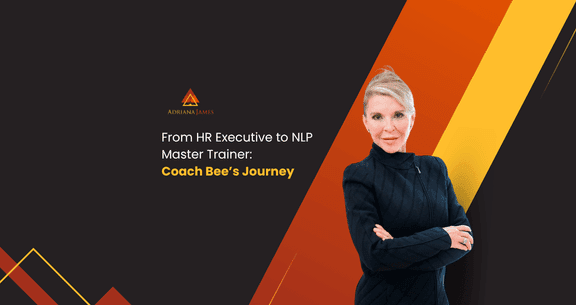
Coach Bee did not begin NLP Trainer’s Training as someone who was new to leadership, business or professional development.
She had already built a senior corporate career.
She had already become a trainer.
She had already studied NLP and hypnotherapy.
What she discovered through training with Dr Adriana James was not simply another collection of techniques.
It was, in her words, a different way of thinking and living.
Her journey from human resources executive in Beirut to NLP Master Trainer illustrates what can happen when an experienced professional is willing to revisit the foundations, question what they think they already know and develop at the level of identity.
A Career Built Around People
Before entering the personal development field, Coach Bee worked as a human resources director in Beirut, Lebanon.
Her role was at the senior executive level, which meant her professional life already involved many of the capabilities associated with leadership and training:
- communicating with different personalities
- navigating organisational pressure
- supporting teams
- making decisions
- resolving challenges
- influencing people across a business
Her later work took her into coaching, training and mental health-related fields.
By 2016, she had been introduced to NLP. From there, she continued into hypnotherapy, Time Line Therapy® and other related areas of study.
She became a trainer in 2021 and progressed to Master Trainer in 2024.
On paper, she was already highly experienced.
But experience did not stop her from recognising that there was more to learn.
From “Survivor” to a New Perspective
Coach Bee’s interest in NLP began during a period when she was trying to make sense of her own experiences.
A conversation in 2015 became an important turning point.
Someone described her as being in a victim position, but in her own mind, she saw herself as a survivor.
That difference in language caught her attention.
Rather than dismissing it, she became curious.
What did the other person mean?
Why were they seeing her experience differently?
That curiosity led her to a training course shortly afterwards.
She initially enrolled simply to understand what the person had been talking about.
Instead, she became deeply engaged with the material.
This is often how NLP journeys begin.
Not with a perfectly formed career plan, but with a question.
Why do I see this experience one way while someone else sees it differently?
What patterns are shaping how I think?
What might change if I learned to interpret my experience differently?
For Coach Bee, those questions opened the door to a much longer journey.
Integrity Led Her Back to the Source
By the time Coach Bee encountered The Tad James Company, she had already trained in NLP, hypnotherapy and Time Line Therapy® through other institutions.
She later became aware that Time Line Therapy® was a trademarked methodology.
Integrity, she explains, is one of her highest values.
She did not want to use or teach a methodology without ensuring that her training and professional practice were properly aligned with the source.
That decision brought her to The Tad James Company.
She initially expected that she would simply complete the Time Line Therapy® requirements.
Instead, she learned that she would need to revisit NLP Practitioner and NLP Master Practitioner training as part of the pathway.
For an already experienced trainer, being asked to repeat earlier levels could have felt unnecessary.
It did not take long for her to see the experience differently.
“It Was More Like the Upgrade”
Coach Bee describes her experience of retaking the material using a memorable comparison.
It was not that the previous training had taught an entirely different subject.
It was, she says, more like moving from a basic phone to the latest high-specification smartphone.
The core category may appear similar, but the depth, capability and experience are completely different.
Her point was not simply that one course contained more information.
It was that NLP began to make sense as an integrated way of thinking, rather than a set of disconnected techniques.
That distinction is central to advanced NLP development.
At an introductory level, it is natural to focus on processes:
- What are the steps?
- What do I say?
- Which technique applies?
- How do I know whether I am doing it correctly?
As experience develops, the emphasis changes.
The practitioner begins to notice the principles connecting the techniques.
They become more flexible.
They rely less on memorised procedures and more on their understanding of how communication, perception, values, state and behavior interact.
For Coach Bee, NLP shifted from something she used into something that influenced how she approached life.
Why an Experienced Trainer Chose Trainer’s Training
At first, Coach Bee approached NLP Trainer’s Training largely out of curiosity.
She was already a successful business trainer.
She had already trained in NLP and hypnotherapy through other institutions.
There was no obvious reason to assume that another trainer programme would change her career dramatically.
But that is precisely what made her experience so valuable.
She could compare the training with what she had already learned and applied.
Her previous trainer education had focused on important practical skills such as:
- preparing material
- structuring a class
- managing participants
- delivering the content effectively
Dr Adriana James’s approach added another dimension.
It worked, Coach Bee says, on her identity as a trainer.
This was no longer only about what she did when standing in front of a class.
It was about who she became when she stepped into the trainer role.
Developing Trainer Identity
Trainer identity can be difficult to explain until someone experiences the difference.
At one level, training is a professional activity.
The trainer enters a room, delivers material, answers questions and completes the session.
At another level, training is a state of being.
The trainer must remain connected to the group, the content, the outcome and their own internal resources simultaneously.
They may need to:
- respond to an unexpected question
- simplify a complex explanation
- challenge a learner respectfully
- change direction when the room becomes disengaged
- manage time without rushing the learning
- maintain confidence when something does not go to plan
A trainer who depends entirely on perfect conditions can struggle when reality becomes unpredictable.
Trainer identity creates a more stable internal foundation.
Coach Bee describes the feeling as becoming “bulletproof” in trainer state—not in the sense of becoming infallible, but of feeling connected to her resources wherever she is and whatever subject she is teaching.
What Trainer State Means to Coach Bee
Coach Bee has an unusually demanding professional schedule.
She works across multiple time zones, including the Middle East, Australia and the United States. She manages three clinics and a training academy.
In that context, trainer state is not an abstract concept.
It is practical.
She describes it as the state in which tiredness and external pressure become less dominant because her attention is fully connected to the training and the people in front of her.
She feels able to access the knowledge, experience and resources stored within her unconscious mind.
This does not mean ignoring health, sleep or physical needs.
It means recognising that performance is influenced not only by circumstances, but by the state from which a person responds to them.
For trainers, speakers and leaders, that distinction can be transformative.
The Ripple Effect Across Her Graduates
One of the strongest measures of a trainer’s development is not how impressive they appear.
It is what happens to the people they teach.
Coach Bee saw the impact of trainer state in one of her own graduates.
The graduate was preparing for a major speaking engagement when the subject was changed just one day before the event.
Understandably, she felt overwhelmed.
Coach Bee reminded her to access her trainer state.
The graduate went on to deliver the talk successfully.
For Coach Bee, this moment demonstrated that the learning had transferred.
Trainer state was not simply something she had experienced in a classroom with Dr Adriana James.
It had become something she could model, teach and pass on to others.
That is the ripple effect of trainer development.
The trainer changes.
Their students change.
Learn more about Public Speaking Training with Dr Adriana James
From Information Flow to International Community
Coach Bee’s academy has approximately 300 graduates.
In her organisation, information often flows in one direction.
Her students bring questions to her, and she is expected to provide answers.
That position can become isolating for experienced professionals.
The more expertise someone develops, the fewer people they may have around them who can challenge their thinking or engage with advanced questions.
Coach Bee describes the international community around The Tad James Company as one of the major benefits of her continued involvement.
It gives her access to like-minded professionals from different countries and contexts.
Why She Recommends the Training
Coach Bee describes NLP Trainer’s Training with Dr Adriana James as one of the best investments she has made in herself.
Her recommendation is not based solely on business growth or certification.
It is based on how the programme affected her personally.
She explains that some professional skills are only used within a specific context. A trainer may feel capable in the classroom but lose access to those same resources elsewhere.
Her experience of trainer state became more transferable.
She could apply the same presence and resourcefulness in professional conversations, relationships and other areas of life.
The tools were available.
The responsibility to use them remained hers.
As she says, training can provide the tools, but each person must decide how fully they apply them.
What Prospective NLP Trainers Can Learn From Coach Bee
Coach Bee’s journey offers several important lessons.
Experience does not eliminate the need for development
In some cases, experience makes advanced training more valuable because the participant can recognise the difference between surface-level technique and deeper integration.
Revisiting the foundations is not necessarily repeating the past
Returning to Practitioner and Master Practitioner content gave Coach Bee a different understanding of material she had already encountered.
The level of the learner changes what they are able to notice.
Integrity can shape a professional pathway
Her decision to align her use of Time Line Therapy® with the recognised source was not simply an administrative choice.
It reflected the values she wanted her professional work to represent.
Trainer development happens at the level of identity
Presentation skills matter.
Trainer identity influences how those skills are accessed when circumstances become difficult or unpredictable.
The impact extends beyond the trainer
The value of Trainer’s Training becomes visible in the confidence, flexibility and capability of the graduates the trainer later supports.
Mastery requires community
Even highly experienced trainers benefit from peers who can offer different perspectives, answer advanced questions and challenge established thinking.
Is NLP Trainer’s Training the Right Next Step?
Coach Bee’s story may resonate particularly strongly with people who are already successful.
Perhaps you already coach.
Perhaps you already facilitate workshops.
Perhaps you regularly speak in front of groups.
Perhaps you have completed NLP Practitioner and Master Practitioner training and are wondering whether NLP Trainer’s Training will add anything substantially new.
Her experience suggests that the value may not come from receiving another set of presentation tips.
It may come from developing a deeper relationship with your own knowledge, state and identity.
The question is not only:
“Can I teach this material?”
It is also:
“Who am I when I teach, and what becomes possible for the people learning from me?”
Explore NLP Trainer’s Training With Dr Adriana James
Dr Adriana James’s upcoming NLP Trainer’s Training is designed for practitioners and professionals ready to develop their communication, facilitation and training capability at a deeper level.
The programme may be relevant whether your goal is to:
- certify NLP students
- expand your coaching practice
- create a signature training programme
- lead groups more effectively
- strengthen your public-speaking skills
- develop greater confidence and flexibility as a trainer
Coach Bee’s journey shows that even an experienced executive, trainer and academy leader can discover another level of growth.
Sometimes the next stage is not about adding more techniques.
It is about becoming the person who can use them with greater integrity, flexibility and impact.
Related resources:
- Time Line Therapy and the Basis of Personality
- Burnout-Proof Your Life
- NLP Training: The Complete Guide
- Public Speaking Training
- Why Great NLP Trainer’s Aren’t Just Great Presenters
- How NLP Trainer’s Training Changes More Than Your Presentation Skills
Disclaimer: The information shared is for educational purposes only and is not intended as medical advice. If you are experiencing health concerns, please consult a qualified medical or mental health professional.