
If you’ve ever wondered what really happens inside NLP Master Practitioner training, not the overview on the website, not the curriculum list, but what it actually feels like to be in “the room” (on Zoom), this recap of Week 1 of our 2026 NLP Master Practitioner AEST intake gives you a clear answer.
And it’s very different from what most people expect.
So what actually happens in NLP Training when you move beyond theory and into real application?
A Global Room, One Objective
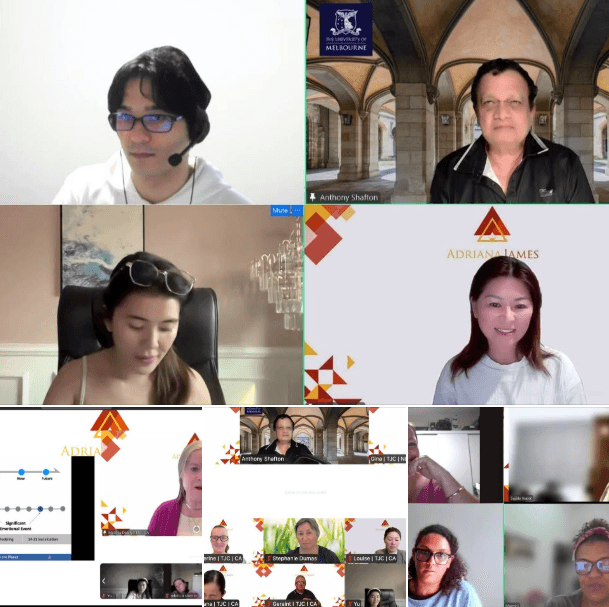
From the first session, one thing was immediately clear: this is not entry-level learning. Participants joined from across the world: the UK, Europe, India, Asia, South Africa, the USA, Australia, Japan, and beyond. Different industries. Different backgrounds. Different starting points. But one shared objective: to move beyond surface-level understanding and learn how to create real change at the level where behavior is actually driven.
Some arrived as experienced coaches looking to deepen their practice. Others came from corporate leadership roles where understanding human behavior means better team performance and clearer decision-making under pressure. Some were therapists integrating unconscious change work into their existing approach. A few were complete beginners who had completed Easy NLP and were ready to jump straight into Master-level training.
What united them was readiness. Not perfection, not years of prior experience, but a decision that they were done circling personal growth from the outside and ready to step fully in.
Curious if this is the right next step for you?
Explore what NLP Master Practitioner training involves and see upcoming intakes.
Day 1: Setting the Standard
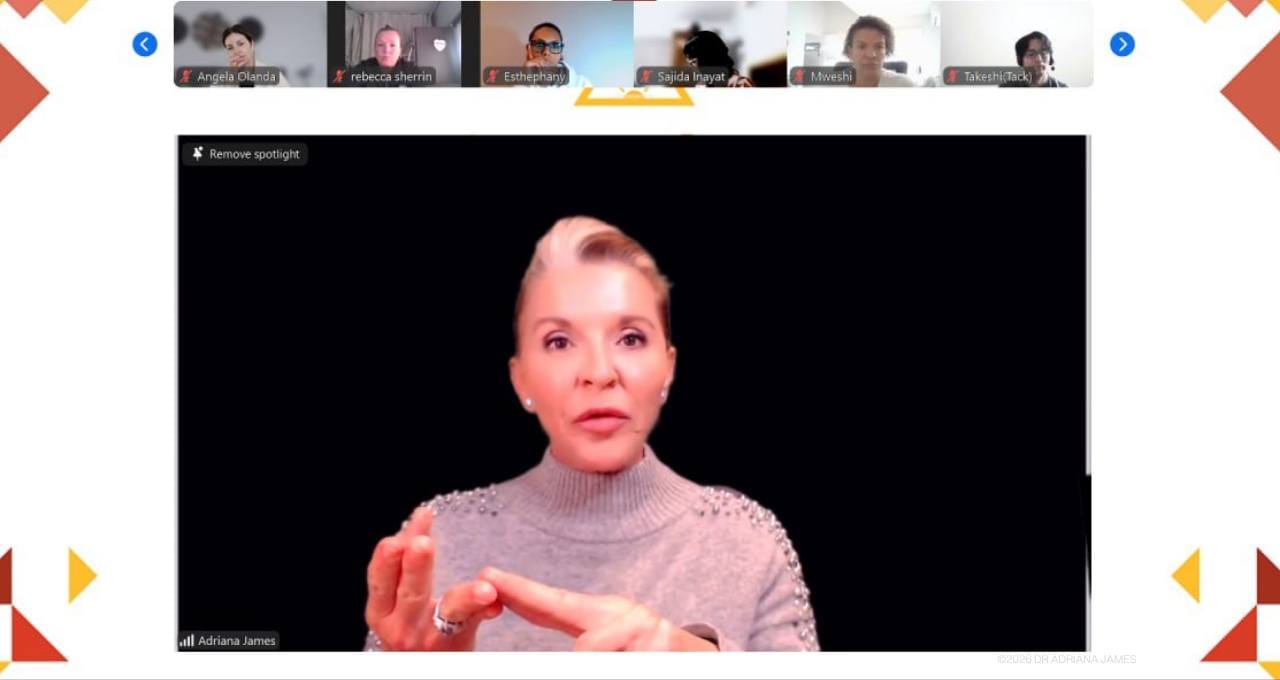
Day 1 opened with Dr. Adriana James welcoming participants and setting the tone for the week ahead. This wasn’t about “learning more techniques” or collecting another certificate. It was about precision, depth, and application. Coaching Assistants supported the training throughout, bringing their expertise and experience to guide participants through Part 1.
From the outset, students were immersed in real-time coaching, structured exercises, practical application, and immediate feedback. Because at this level, understanding isn’t enough. You can know what to do intellectually and still not be able to create the transformation you’re aiming for. Application is everything. Calibration is everything. Seeing what’s actually happening beneath someone’s words and responding to that, not to what you think should be happening, is everything.
The room (virtual though it was) had a particular quality to it. Focused. Intense, but not stressful. Collaborative, but with everyone doing their own internal work at the same time. There’s a difference between learning in a lecture hall where you’re passively receiving information and learning in an environment where you’re expected to apply what you’re hearing within minutes of hearing it. This was the latter.
This is where many people begin to understand what happens in NLP training at Master Practitioner level and that it’s not passive learning, it’s immediate application.
Day 2: From Behavior to Structure
Day 2 started with a review of Chaining Anchors, a technique taught in NLP Practitioner and applied at Master Practitioner level. It’s one of the most effective ways to address procrastination and build sustainable motivation. Lakkana and Shane, Master Trainer Candidates for 2026, led this session, demonstrating how the same technique that seemed simple at Practitioner level becomes powerful when applied with precision.
From there, the group dove into Meta Programs with NLP Master Trainer Cristina Moise and Master Trainer Candidate Catherine. Meta Programs are unconscious mental filters that determine how people make decisions, what they focus on, and how they interpret the world around them. The session included live demonstrations of how to discover someone’s Meta Programs, followed by exercise time where participants practiced identifying these patterns in real time.
Then the group moved into the Negotiation Model. Participants were split into two groups, each working on their own position with different goals and priorities. Then Cristina used the Negotiation Model to mediate the two sides, demonstrating how to facilitate understanding between opposing viewpoints. Watching the mediation process unfold live showed participants what Master Practitioner looks like in practice: not just theory, but live demos, real exercises, and deep skill-building.
If you’ve ever wondered what happens in NLP training when it comes to real-world communication and influence, this is where it becomes clear.
This is where most people realise the difference.
NLP Master Practitioner training isn’t about learning more, it’s about seeing what’s actually driving behavior.
Watch the Advanced NLP Masterclass to experience this in action.
Day 3: Understanding How People Think
Day 3 brought the start of Values Levels teaching, based on Dr. Clare Graves’ work, with Dr. Adriana James leading a deep dive into each Values Level Thinking, teaching the characteristics and how to identify the key words and thinking patterns of each values level in business, leadership, personal growth, relationships, and beyond.
Dr. Adriana James is the author of “Values And The Evolution of Consciousness,” which explains using accessible examples, what happens in each Values Level and why individuals and particular parts of the world exhibit specific aspects of values level thinking. This session focused on understanding thinking itself, how people process information and also how they make decisions at different levels of consciousness.
This is not personality typing. It’s not putting people in boxes or labeling them. It’s a framework for understanding why people think the way they do, why conflict happens between individuals and groups even when everyone has good intentions, and how different levels of thinking influence behavior in ways that aren’t immediately obvious. And most importantly, it gives you the ability to meet people where they are instead of trying to force them into your way of thinking or assuming they should already see what you see.
This is the depth of Master Practitioner: not just techniques, but understanding how people think at different levels of consciousness.
Day 4: Values in Practice and Time Line Therapy® Review
Day 4 brought multiple layers of learning together with the day beginning with a Time Line Therapy® Practitioner review session led by Master Trainer Candidate, Melissa.
The questions from students showed a deep interest in the techniques and how they work at the unconscious level. This review session ensured everyone had solid foundations in Time Line Therapy® before moving into the advanced techniques that will be taught in Part 2 of Master Practitioner starting May 23, 2026.
Dr. Adriana James then continued the deep dive into Values Levels, explaining why individuals and communities demonstrate particular ways of thinking. Building on the previous day’s foundation, this session added layers of nuance about how values level thinking shows up in different contexts, whether that be business decisions, leadership styles, relationship dynamics, and personal growth patterns.
In the afternoon, Dr Adriana James worked with students and taught how to interpret the Coaching Values Inventory (CVI). This is where theory becomes practical application. Students learned to read the data, understand what it reveals about someone’s values hierarchy, and translate that understanding into actionable coaching insights.
Then students paired up in an exercise and interpreted each other’s CVI, providing them each with a snapshot of their values levels.
This exercise is important for Master NLP Coaches so that their clients receive the best coaching experience in the context of their presenting problem. It’s one thing to understand values levels conceptually. It’s another to sit across from a real person, look at their actual data, and use that information to guide a conversation that meets them exactly where they are.
This is where the work becomes personal. Because you’re no longer learning “about people” in an abstract sense. You’re learning how to work with them in real time, using concrete tools that reveal what’s driving their behavior, decisions, and the challenges they’re experiencing.
This is the depth of Master Practitioner: advanced techniques, real application, and personalized coaching tools that make the difference between surface-level work and transformation at the root.
If this is the kind of change you’ve been looking for…
This is exactly what NLP Master Practitioner training is designed to deliver.
See how the full program works.
Day 6: Modeling Excellence
By the final day of Week 1, excited students and Master Trainer Candidates arrived ready for a full day of learning and exercises. The morning began with the last session of Time Line Therapy® Practitioner Review with Melissa, ensuring everyone was prepared for the advanced techniques coming in Part 2.
Dr. Adriana James then taught the key elements of successful training techniques – essential knowledge for anyone who wants to teach, train, or present at a high level, not just for those pursuing Trainer-level certification.
The final session of the day was with Dr. Adriana James and NLP Master Trainer Cristina Moise, who demonstrated how to model excellence. This is the foundation of how NLP was originally developed, not by creating theories about how people should think or behave, but by studying what actually works in high performers and replicating it.
This session intrigued the students, who asked the most amazing questions about how high performers think, how they make decisions, and how they structure their internal processes differently from people who struggle in the same situations. Students didn’t just observe. They questioned, analyzed, and began applying these patterns themselves.
Because at Master level, the goal isn’t to follow someone else’s map. It’s to understand how maps are built so you can create your own. It’s to see the structure of excellence clearly enough that you can recognize it, replicate it, and teach it to others.
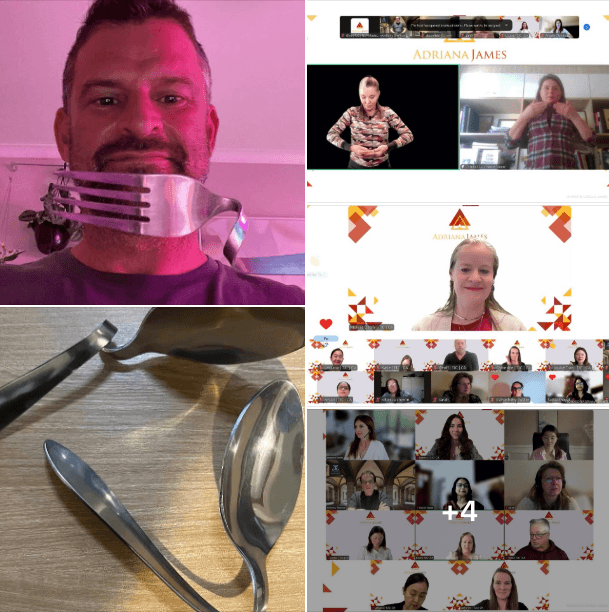
And then… the spoons went bending! 🥄
Yes, spoon bending happened. But not as a gimmick or a parlor trick. As a demonstration of how belief, focus, and neurology interact in ways that challenge assumptions about what’s possible. Not in a theoretical sense, but in a way you can experience directly with a piece of metal in your hands that wasn’t bent thirty seconds ago and is now.
It’s not about the spoon. It’s about what becomes possible when you stop operating from limiting beliefs about what you’re capable of. And that’s a recurring theme throughout the training: you don’t just learn concepts. You experience them. You don’t just understand intellectually. You go through it yourself, so when you’re working with clients or leading teams or navigating your own challenges, you’re not guessing. You know.
What Week 1 Really Represents
When you step back and look at Week 1 as a whole, it’s not about techniques or tools or adding more to your existing skill set. It’s about developing clarity in how people think, control over your own internal state regardless of external pressure, precision in communication so your words land the way you intend them to, awareness of unconscious patterns that drive behavior beneath the surface, and the ability to create change at the root instead of managing symptoms indefinitely.
These are not “nice-to-have” skills. They are the capabilities that increasingly define high performers in today’s world. The ability to think clearly under pressure. To communicate precisely when stakes are high. To understand what’s actually driving someone’s behavior instead of reacting to what they’re saying. To lead effectively when there’s no clear playbook. To influence outcomes without force or manipulation.
Why This Matters Now
We’re in a time where AI is accelerating rapidly, basic information is abundant and accessible to everyone, and technical skills are evolving faster than most people can keep up with. But the differentiator is becoming clearer every year: human capability. The ability to communicate clearly when emotions are running high. To make sound decisions under pressure and uncertainty. To understand people at a level that goes beneath their words. To lead effectively when the path forward isn’t obvious. To influence outcomes in ways that feel collaborative rather than coercive.
This is exactly the level where NLP Master Practitioner operates. Not at the level of tips and tricks or surface techniques. At the level of structure, identity, unconscious patterns, and the systems that drive human behavior and performance.
Want to improve your communication and influence immediately?
Download the 60-second Elevator Pitch training
What Happens Next: Part 2
Week 1 is just the beginning. Part 2, which runs May 23–31 for the AEST intake and July 11–19 for the PDT intake, moves into advanced Time Line Therapy® techniques, deeper identity-level work, complex intervention strategies, master-level application and the all important Breakthrough sessions. This is where everything integrates. Where the pieces that seemed separate in Week 1 come together into a cohesive whole. And where participants move from understanding concepts to embodying mastery.
There Is Still One Intake Available in 2026
If you’ve been watching from the outside, circling this decision, wondering if it’s the right time or if you’re ready enough, there is still one opportunity to experience this level of training in 2026.
NLP Master Practitioner – PDT Intake
📍 Part 1: June 7–12, 2026
📍 Part 2: July 11–19, 2026
💻 Live, online with Dr. Adriana James
Over 2,100 Master Practitioners have been trained across 47 countries. Mastery is still rare, and the path has never been clearer.
Your Next Step
If you’re ready to move beyond surface-level personal development, theory without application, and knowing what to do but not actually doing it…and into aligned performance, clear thinking, confident communication, and real behavioral change that doesn’t require constant willpower to maintain, then this is the next step.
Explore the NLP Master Practitioner training and upcoming PDT intake to learn more.
Final Thought
Week 1 didn’t just teach skills. It changed how participants see themselves, other people, and what’s possible when you understand the structure behind behavior. Because when you can see that structure clearly, you’re no longer just reacting to life as it happens. You’re shaping it intentionally. And that changes everything.
FAQs
What happens in NLP Master Practitioner training?
NLP Master Practitioner training focuses on advanced communication, behaviour change, values alignment, and unconscious pattern work through live practice and real-time feedback.
Is NLP Master Practitioner training practical or theoretical?
It is highly practical. Participants apply techniques immediately through exercises, coaching, and live demonstrations.
Can NLP Master Practitioner training be done online?
Yes. Live online NLP training includes real-time interaction, coaching practice, and feedback, making it as effective as in-person training.
What is Time Line Therapy® in NLP training?
Time Line Therapy® is a structured process used to release negative emotions and limiting beliefs at their root, rather than managing symptoms.
Do I need NLP Practitioner before Master Practitioner?
Not always. Some programs allow you to complete Practitioner-level training through preparation courses like our Easy NLP before starting Master Practitioner.
What skills do you gain in NLP Master Practitioner training?
You develop advanced communication, emotional intelligence, behavioural change skills, leadership capability, and coaching precision.